CUPED
We call 'Controlled-experiment Using Pre-Experiment Data' (CUPED) a scenario where a treatment is randomly assigned to participants, and we have pre-experiment data of participants like pre-treatment outcome.
Treatment - new product category for users.
We will test hypothesis:
- There is no difference in LTV between treatment and control groups.
- There is a difference in LTV between treatment and control groups.
Causal Assumptions
Unconfoundedness: random assignment of treatment. Will be tested with SRM and Balance Check
Overlap: each unit has a non-zero probability of assignment to every arm. By design
SUTVA: no interference and consistent treatment definitions. By design
Pre-treatment covariate: exists and predicts outcome
Data
For the analysis you need data in pandas dataframe:
- treatment column in binary format (1/0)
- outcome column numeric format, measured after treatment time
- user_id column (Optional, but useful)
- confounders columns (Optional, measured before treatment time, numeric format, used for causal assumption check, includes covariates for CUPED)
We will take data from Causalis DGP. Read more at https://causalis.causalcraft.com/articles/make_cuped_tweedie_26
| y | d | tenure_months | avg_sessions_week | spend_last_month | discount_rate | platform_ios | platform_web | m | m_obs | tau_link | g0 | g1 | cate | y_pre | _latent_A | y_pre_2 | |
|---|---|---|---|---|---|---|---|---|---|---|---|---|---|---|---|---|---|
| 0 | 3.734763 | 0.0 | 14.187461 | 2.0 | 57.355300 | 0.158164 | 1.0 | 0.0 | 0.5 | 0.5 | 0.103825 | 8.487966 | 9.416605 | 0.928639 | 17.972138 | 0.304717 | 10.783283 |
| 1 | 0.746406 | 1.0 | 6.352893 | 3.0 | 46.700946 | 0.085722 | 0.0 | 0.0 | 0.5 | 0.5 | 0.030781 | 8.487966 | 8.753301 | 0.265335 | 0.000000 | -1.039984 | 0.000000 |
| 2 | 13.040584 | 1.0 | 18.910153 | 9.0 | 80.136187 | 0.175115 | 1.0 | 0.0 | 0.5 | 0.5 | 0.357355 | 8.487966 | 12.133915 | 3.645949 | 34.771837 | 0.750451 | 24.866330 |
| 3 | 34.582113 | 1.0 | 7.927627 | 4.0 | 33.718224 | 0.152718 | 1.0 | 0.0 | 0.5 | 0.5 | 0.065554 | 8.487966 | 9.063025 | 0.575059 | 349.163943 | 0.940565 | 209.498366 |
| 4 | 0.000000 | 1.0 | 11.106925 | 2.0 | 92.064518 | 0.077390 | 0.0 | 0.0 | 0.5 | 0.5 | 0.056036 | 8.487966 | 8.977172 | 0.489206 | 0.000000 | -1.951035 | 0.243980 |
CausalData(df=(20000, 9), treatment='d', outcome='y', confounders=['avg_sessions_week', 'spend_last_month', 'discount_rate', 'platform_ios', 'platform_web', 'y_pre', 'y_pre_2'])
EDA
| treatment | count | mean | std | min | p10 | p25 | median | p75 | p90 | max | |
|---|---|---|---|---|---|---|---|---|---|---|---|
| 0 | 0 | 10049 | 8.867136 | 21.097599 | 0.0 | 0.0 | 0.0 | 0.276901 | 9.266134 | 24.454852 | 347.095992 |
| 1 | 1 | 9951 | 9.870188 | 25.879015 | 0.0 | 0.0 | 0.0 | 0.000000 | 10.409916 | 27.439125 | 956.413897 |
| treatment | n | outlier_count | outlier_rate | lower_bound | upper_bound | has_outliers | method | tail | |
|---|---|---|---|---|---|---|---|---|---|
| 0 | 0 | 10049 | 1080 | 0.107473 | -13.899201 | 23.165335 | True | iqr | both |
| 1 | 1 | 9951 | 1063 | 0.106823 | -15.614875 | 26.024791 | True | iqr | both |
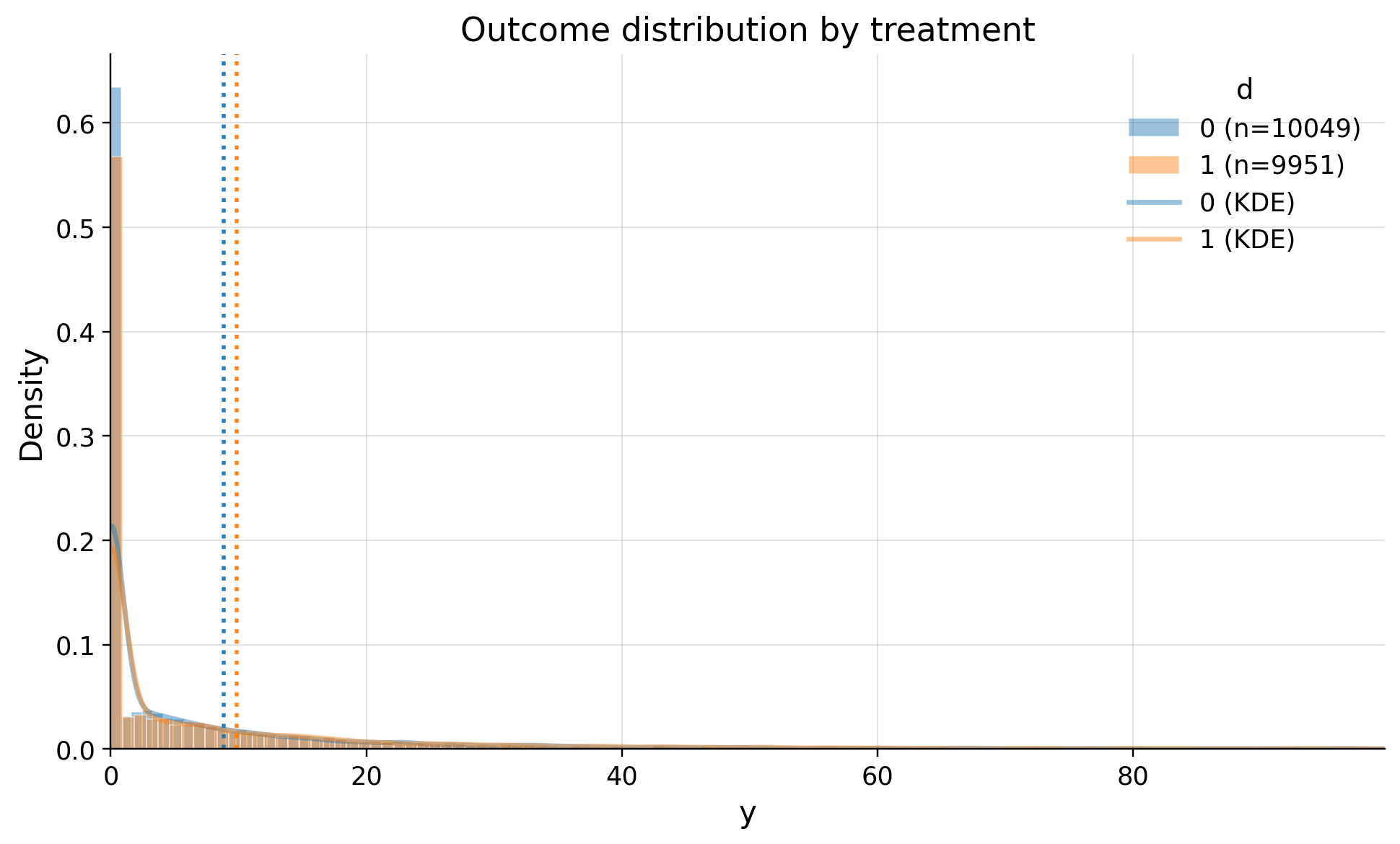
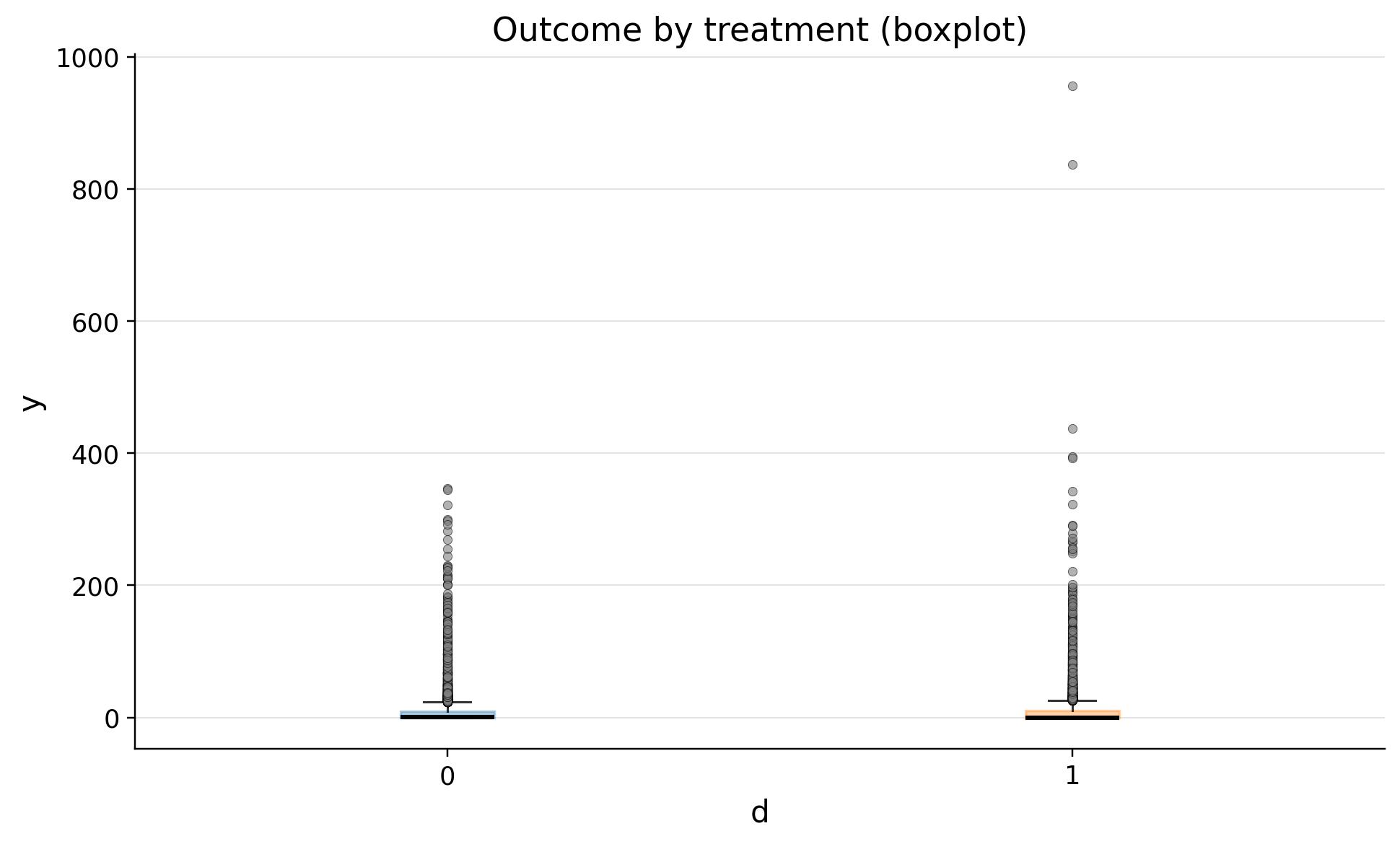
We see heavy tale distribution
SRM
Some system is randomly splitting users. Half must have new onboarding, other half has not. We should monitor the split with SRM test. Read more at https://causalis.causalcraft.com/articles/srm
SRMResult(status=no SRM, p_value=0.48833, chi2=0.4802)
Confounders balance
| confounders | mean_d_0 | mean_d_1 | abs_diff | smd | ks_pvalue | |
|---|---|---|---|---|---|---|
| 0 | spend_last_month | 73.787667 | 75.159017 | 1.371350 | 0.019726 | 0.20812 |
| 1 | platform_ios | 0.304309 | 0.297357 | 0.006952 | -0.015158 | 0.96771 |
| 2 | y_pre | 7928.516448 | 20967.672427 | 13039.155979 | 0.014621 | 0.36084 |
| 3 | y_pre_2 | 4760.192129 | 12583.709202 | 7823.517073 | 0.014621 | 0.38473 |
| 4 | avg_sessions_week | 4.963379 | 5.015677 | 0.052297 | 0.012405 | 0.49401 |
| 5 | discount_rate | 0.100420 | 0.099996 | 0.000424 | -0.006421 | 0.36146 |
| 6 | platform_web | 0.050950 | 0.050749 | 0.000202 | -0.000918 | 1.00000 |
- SRM is good
- SMD < 0.1 and ks_pvalue > 0.05
Split is random. Uncofoundedness is true
Inference with CUPED
Read more about model specification at https://causalis.causalcraft.com/articles/cuped-model
| value | |
|---|---|
| field | |
| estimand | ATE |
| model | CUPEDModel |
| value | 0.8155 (ci_abs: 0.2724, 1.3587) |
| value_relative | 9.0633 (ci_rel: 2.7548, 15.3718) |
| alpha | 0.0500 |
| p_value | 0.0033 |
| is_significant | True |
| n_treated | 9951 |
| n_control | 10049 |
| treatment_mean | 9.8702 |
| control_mean | 8.8671 |
| time | 2026-05-09 |
Refutation
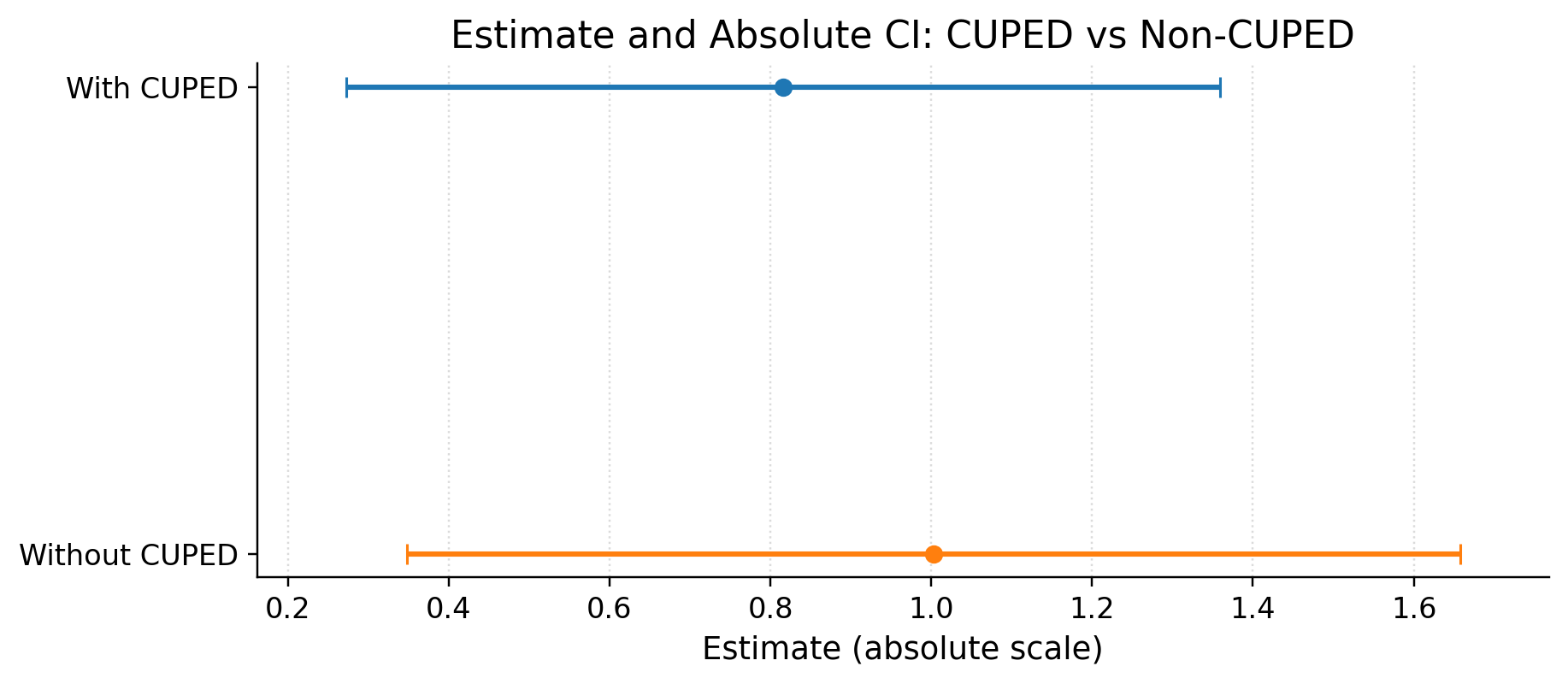
var reduction with CUPED %: 31.179489563275986
| test_id | test | flag | value | threshold | message | |
|---|---|---|---|---|---|---|
| 0 | design_rank | Design rank | GREEN | rank=6, k=6 | rank == k | Design matrix is full rank. |
| 1 | condition_number | Condition number | GREEN | 3335417.561613 | <= 1.000e+08 | Condition number is within expected range. |
| 2 | near_duplicates | Near-duplicate covariates | YELLOW | 1 | red if >= 3 | Near-duplicate covariate pairs detected. |
| 3 | vif | Variance inflation factor | RED | 6485299680.233781 | yellow: > 20, red: > 40 | Very large VIF indicates severe multicollinearity. |
| 4 | ate_gap | Adjusted vs naive ATE | GREEN | 0.561334 | yellow: > 2.00, red: > 2.50 | Adjusted and naive ATE are reasonably aligned. |
| 5 | residual_tails | Residual extremes | RED | max|std resid|=27.8 | yellow > 7, red > 10 | Extremely large standardized residuals; outliers likely dominate. |
| 6 | leverage | Leverage | RED | max_h=0.91, n_high=653 | yellow if max_h > 50.0006, red if max_h > max(0.5, 100.0006) | Extreme leverage points detected. |
| 7 | cooks | Cook's distance | RED | max=1301, n_high=778 | yellow if max Cook's > 0.1, red if > 1 | Strongly influential observations detected. |
| 8 | hc23_stability | HC2/HC3 stability | GREEN | min(1-h)=9.004e-02, n_tiny=0 | min(1-h) >= 1.0e-06 | HC2/HC3 stability check passed. |
| 9 | winsor_sensitivity | Winsor sensitivity | GREEN | 0.304010 | yellow: > 1.00 SE, red: > 2.00 SE | Winsorized refit is close to baseline ATE. |
let's compare it to oracle effect
Ground truth ATE is 1.2383515933360814