DML ATE Example
This notebook covers scenario:
| Is RCT | Treatment | Outcome | EDA | Estimands | Refutation |
|---|---|---|---|---|---|
| Observational | Binary | Continuous | Yes | ATE | Yes |
We will estimate Average Treatment Effect (ATE) of binary treatment on continuous outcome. It shows explonatary data analysis and refutation tests
Generate data
Let's generate data of how feature (Treatment) impact on ARPU (Outcome) with linear effect (theta) = 1.8
| y | d | tenure_months | avg_sessions_week | spend_last_month | premium_user | urban_resident | |
|---|---|---|---|---|---|---|---|
| 0 | 4.127714 | 0.0 | 27.656605 | 5.352554 | 72.552568 | 1.0 | 0.0 |
| 1 | 11.122008 | 1.0 | 11.520191 | 6.798247 | 188.481287 | 1.0 | 0.0 |
| 2 | 10.580393 | 1.0 | 33.005414 | 2.055459 | 51.040440 | 0.0 | 1.0 |
| 3 | 6.982844 | 1.0 | 35.286777 | 4.429404 | 166.992239 | 0.0 | 1.0 |
| 4 | 10.899381 | 0.0 | 0.587578 | 6.658307 | 179.371126 | 0.0 | 0.0 |
EDA
{'n_rows': 10000, 'n_columns': 7}
General dataset information
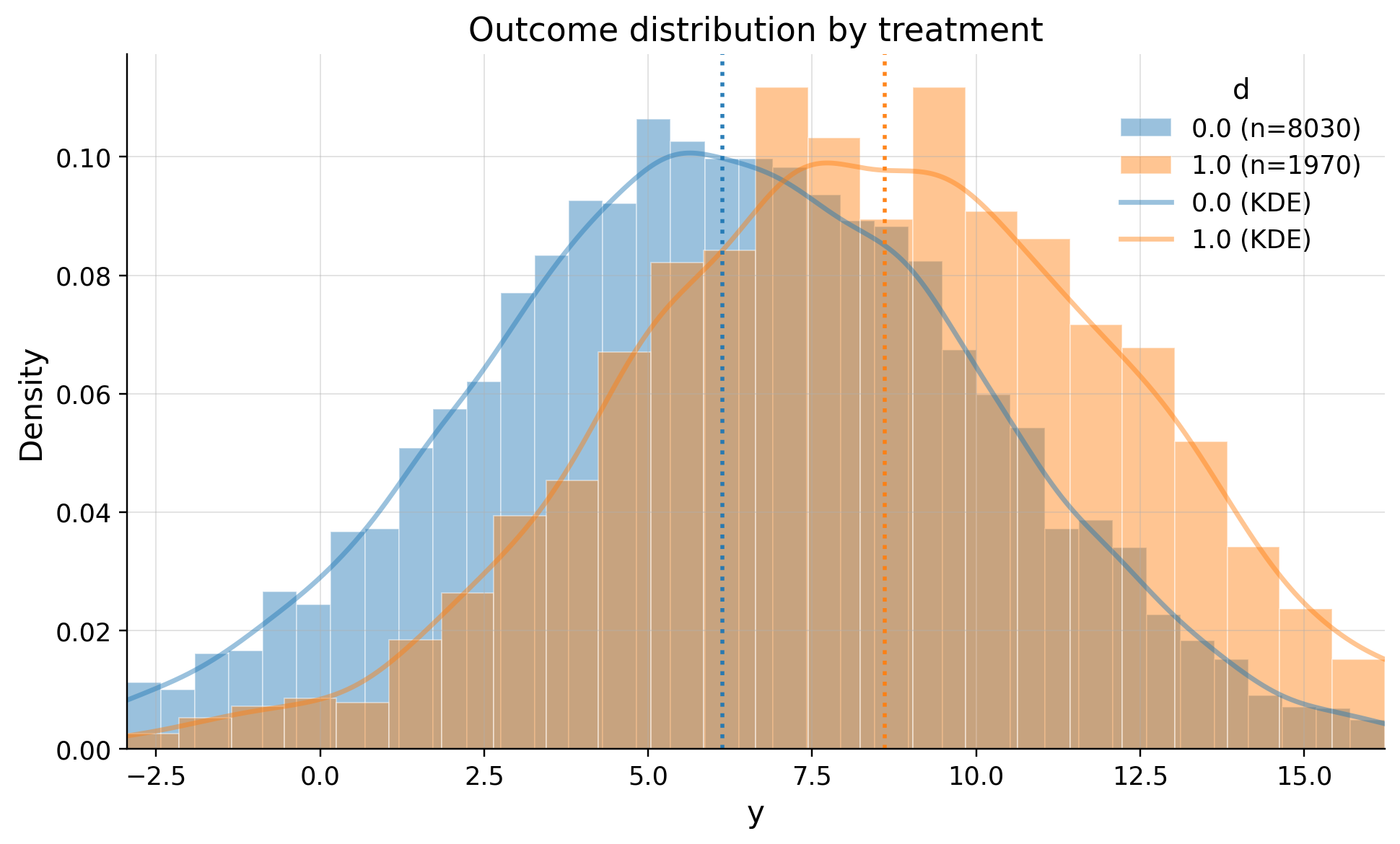
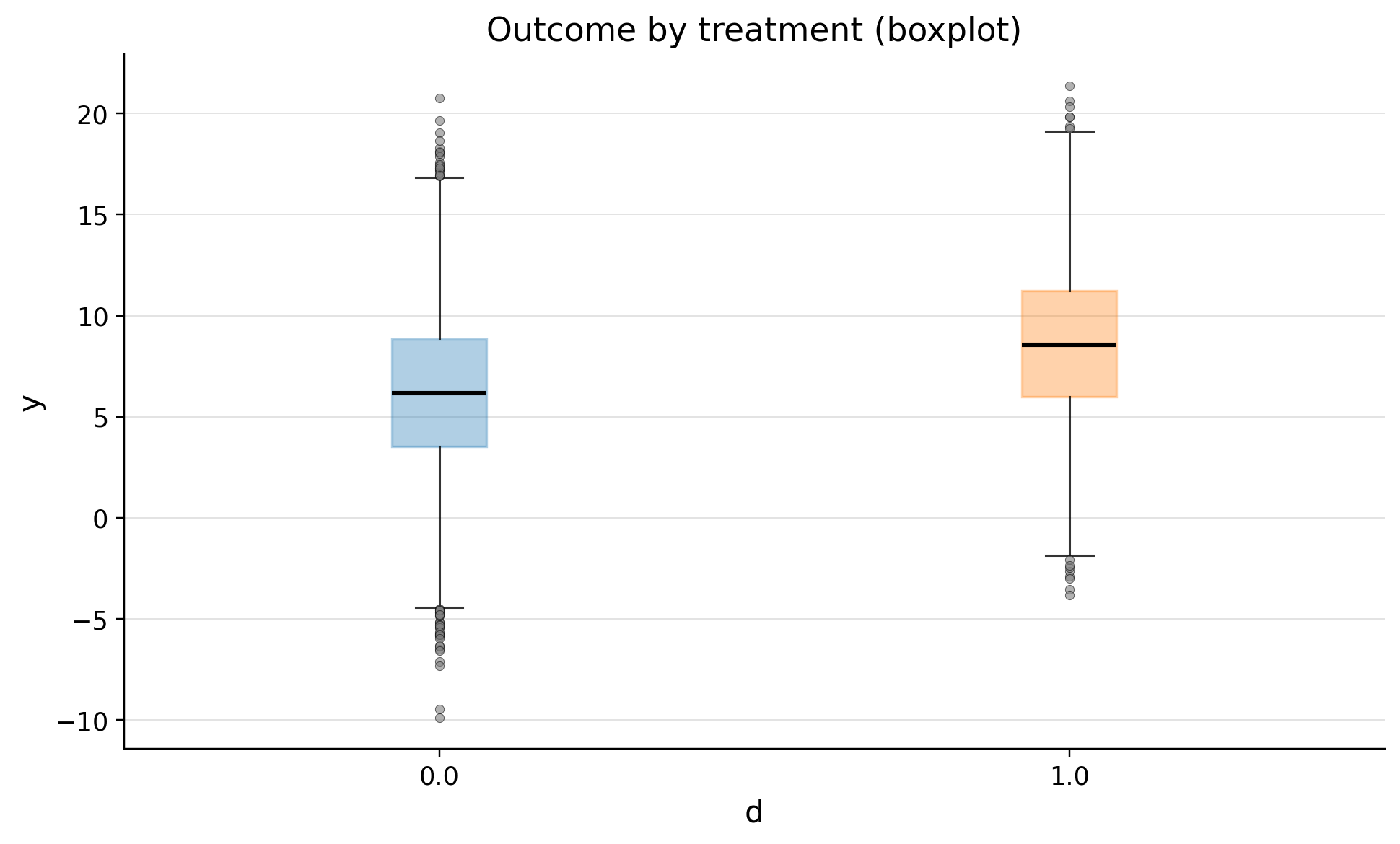
Let's see how outcome differ between clients who recieved the feature and didn't
| count | mean | std | min | p10 | p25 | median | p75 | p90 | max | |
|---|---|---|---|---|---|---|---|---|---|---|
| treatment | ||||||||||
| 0.0 | 8030 | 6.137433 | 3.933863 | -9.866447 | 1.118291 | 3.517427 | 6.157583 | 8.847907 | 11.114776 | 20.770359 |
| 1.0 | 1970 | 8.608973 | 3.942856 | -3.821492 | 3.666892 | 5.986613 | 8.560912 | 11.247429 | 13.552612 | 21.377687 |
Propensity
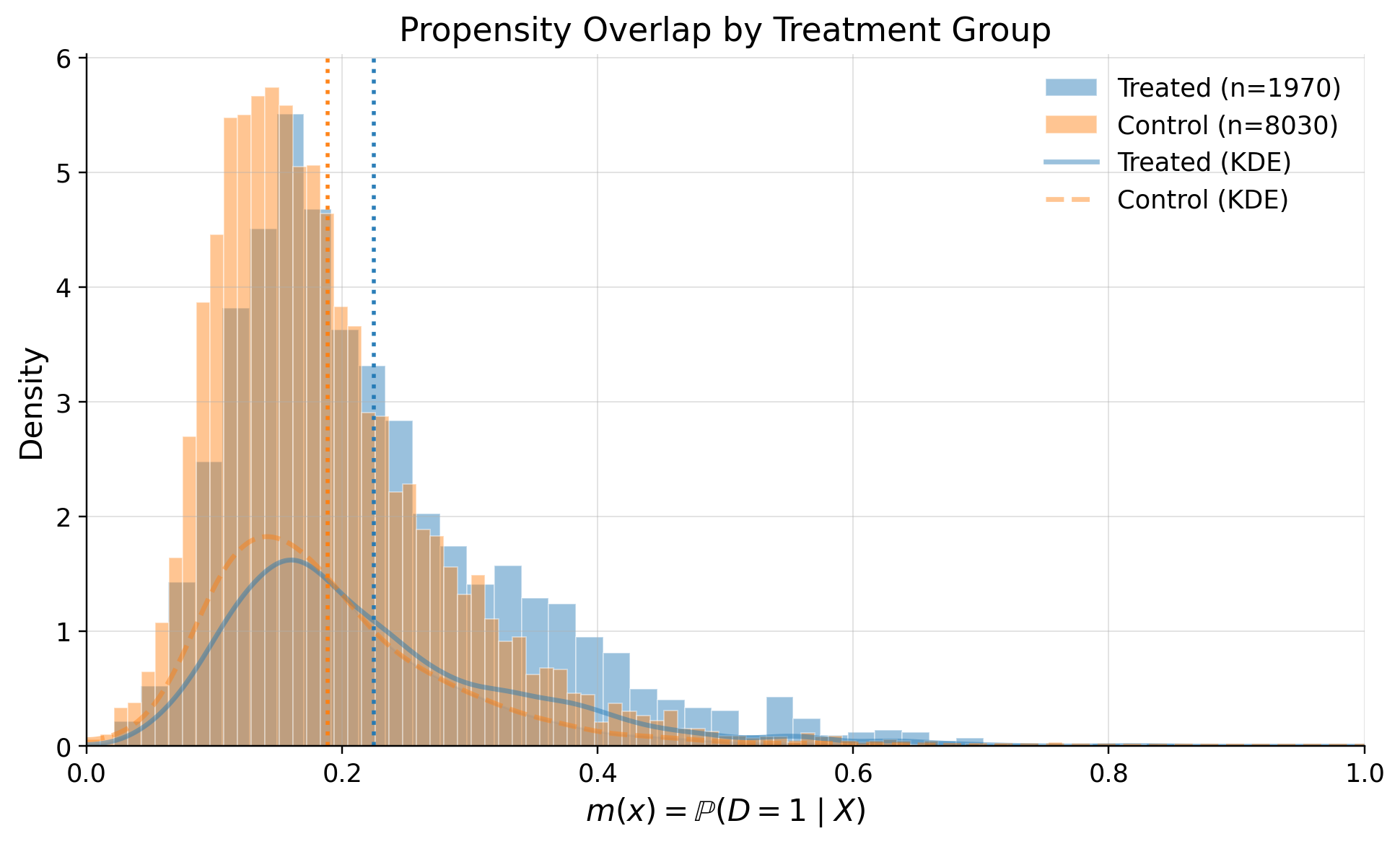
Now let's examine how propensity score differ treatments
| mean_t_0 | mean_t_1 | abs_diff | smd | ks | ks_pvalue | |
|---|---|---|---|---|---|---|
| confounders | ||||||
| premium_user | 0.218057 | 0.382234 | 0.164176 | 0.364037 | 0.164176 | 1.061599e-37 |
| tenure_months | 23.405355 | 25.799499 | 2.394143 | 0.199024 | 0.087485 | 5.511096e-11 |
| avg_sessions_week | 4.976354 | 5.302999 | 0.326645 | 0.163509 | 0.075782 | 2.382131e-08 |
| urban_resident | 0.587547 | 0.655330 | 0.067783 | 0.140072 | 0.067783 | 9.127269e-07 |
| spend_last_month | 99.288113 | 104.941250 | 5.653137 | 0.097172 | 0.057348 | 5.761025e-05 |
ROC AUC from PropensityModel: 0.5926
Positivity check from PropensityModel: {'bounds': (0.05, 0.95), 'share_below': 0.0121, 'share_above': 0.0, 'flag': False}
| feature | shap_mean | shap_mean_abs | exact_pp_change_abs | exact_pp_change_signed | |
|---|---|---|---|---|---|
| 0 | num__spend_last_month | 0.000299 | 0.166002 | 0.027438 | 0.000047 |
| 1 | num__premium_user | -0.000269 | 0.306301 | 0.052687 | -0.000042 |
| 2 | num__urban_resident | 0.000245 | 0.158900 | 0.026210 | 0.000039 |
| 3 | num__avg_sessions_week | -0.000141 | 0.174082 | 0.028841 | -0.000022 |
| 4 | num__tenure_months | -0.000135 | 0.194878 | 0.032482 | -0.000021 |
Outcome regression
Let's analyze how confounders predict outcome
{'rmse': 3.656989617205263, 'mae': 2.90424413216463}
| feature | shap_mean | |
|---|---|---|
| 0 | avg_sessions_week | -0.000502 |
| 1 | spend_last_month | 0.000350 |
| 2 | urban_resident | 0.000245 |
| 3 | premium_user | -0.000055 |
| 4 | tenure_months | -0.000038 |
Inference
Now time to estimate ATE with Double Machine Learning
1.766253520771568 0.0 (1.5329683790491713, 1.9995386624939646)
True theta in our data generating proccess was 1.8
Refutation
Overlap
| metric | value | flag | |
|---|---|---|---|
| 0 | edge_0.01_below | 0.000000 | GREEN |
| 1 | edge_0.01_above | 0.000000 | GREEN |
| 2 | edge_0.02_below | 0.001000 | GREEN |
| 3 | edge_0.02_above | 0.000000 | GREEN |
| 4 | KS | 0.139672 | GREEN |
| 5 | AUC | 0.592382 | GREEN |
| 6 | ESS_treated_ratio | 0.742224 | GREEN |
| 7 | ESS_control_ratio | 0.970455 | GREEN |
| 8 | tails_w1_q99/med | 6.278831 | GREEN |
| 9 | tails_w0_q99/med | 2.844508 | GREEN |
| 10 | ATT_identity_relerr | 0.037683 | GREEN |
| 11 | clip_m_total | 0.000100 | GREEN |
| 12 | calib_ECE | 0.036215 | GREEN |
| 13 | calib_slope | 0.520588 | RED |
| 14 | calib_intercept | -0.637457 | RED |
Score
| metric | value | flag | |
|---|---|---|---|
| 0 | se_plugin | 1.190252e-01 | NA |
| 1 | psi_p99_over_med | 1.355647e+01 | YELLOW |
| 2 | psi_kurtosis | 6.047594e+01 | RED |
| 3 | max_|t|_g1 | 5.463687e+00 | RED |
| 4 | max_|t|_g0 | 1.384511e+00 | GREEN |
| 5 | max_|t|_m | 1.388284e+00 | GREEN |
| 6 | oos_tstat_fold | 1.241609e-15 | GREEN |
| 7 | oos_tstat_strict | 1.241615e-15 | GREEN |
SUTVA
1.) Are your clients independent (i)? 2.) Do you measure confounders, treatment, and outcome in the same intervals? 3.) Do you measure confounders before treatment and outcome after? 4.) Do you have a consistent label of treatment, such as if a person does not receive a treatment, he has a label 0?
Uncofoundedness
| metric | value | flag | |
|---|---|---|---|
| 0 | balance_max_smd | 0.021956 | GREEN |
| 1 | balance_frac_violations | 0.000000 | GREEN |
{'theta': 1.766253520771568, 'se': 0.11902521860734187, 'level': 0.95, 'z': 1.959963984540054, 'sampling_ci': (1.5329683790491713, 1.9995386624939646), 'theta_bounds_confounding': (1.6875916811818483, 1.8449153603612876), 'bias_aware_ci': (1.4543065394594517, 2.0782005020836842), 'max_bias': 0.07866183958971962, 'sigma2': 13.136641553423134, 'nu2': 0.43676740621591587, 'params': {'cf_y': 0.01, 'cf_d': 0.01, 'rho': 1.0, 'use_signed_rr': False}}
| cf_y | cf_d | rho | theta_long | theta_short | delta | |
|---|---|---|---|---|---|---|
| d | 0.000034 | 3.037675e-07 | -1.0 | 1.766254 | 1.845679 | -0.079425 |